

Most people assume taxis run around the clock simply because someone out there always needs a ride. That assumption is half right. Understanding why taxis operate 24 hours requires looking at a mix of public safety imperatives, hard market economics, and regulatory pressure that together make continuous availability not just convenient but necessary. The roads between 9 p.m. and 3 a.m. are genuinely more dangerous, demand patterns are far less predictable than daylight hours, and the consequences of a coverage gap fall hardest on people with the fewest alternatives.
Table of Contents
- Key Takeaways
- Why taxis operate 24 hours: the safety case
- Market demand and the economics behind all-night service
- Regulatory frameworks shaping 24-hour taxi practices
- Challenges in delivering true 24/7 coverage
- Benefits of 24-hour taxi services for passengers and communities
- My take on what most people get wrong about night service
- Ready for a ride that does not quit at midnight?
- FAQ
Key Takeaways
| Point | Details |
|---|---|
| Safety drives night coverage | Nighttime roads carry significantly higher rates of alcohol impairment, making taxis a critical alternative. |
| Economics fund the off-peak hours | Airport and corporate contracts subsidize the less profitable late-night shifts. |
| Regulations raise the bar | Countries like Finland now mandate driver training and taximeter standards to protect the public around the clock. |
| Coverage is not uniform | Suburban riders face longer waits and thinner availability compared to city centers and nightlife zones. |
| Communities depend on access | Shift workers, elderly riders, and nightlife patrons all rely on taxis when no other transport runs. |
Why taxis operate 24 hours: the safety case
The single most compelling reason taxis maintain taxis 24 hour service is what happens when they do not. Nighttime fatalities spike sharply, with 30% of drivers involved in fatal crashes between 9 p.m. and 3 a.m. testing positive for alcohol impairment, compared to just 10% during daytime hours. Nearly 70% of those deaths happen on dark, unlit roads. That is not a marginal risk. It is a structural problem that taxis and ride services directly counteract by giving people a sober alternative before they get behind the wheel.
Beyond drunk driving, nighttime travel creates distinct challenges for people who have no car, are too tired to drive safely, or feel vulnerable waiting at a bus stop in the dark. Taxis serve a protective function for:
- Elderly passengers who cannot safely walk long distances after dark
- Women and other vulnerable individuals traveling alone at night
- People returning from medical appointments or hospital visits at non-standard hours
- Shift workers finishing late at factories, hospitals, and logistics centers when public transit has stopped running
Public transportation rarely fills this gap completely. Most bus and subway networks thin out significantly after midnight, and in many mid-size American cities, they stop entirely. Taxis around the clock exist precisely because that gap is real and the stakes of leaving it unfilled are high.
Fatigue and impaired driving during late-night hours compound the darkness itself, making the case for professional drivers even stronger than it appears on paper. A trained taxi driver who knows the roads, stays sober, and has a commercial incentive to deliver passengers safely represents a meaningful upgrade over the average person driving themselves home at 2 a.m. after a long night.
Pro Tip: If you are planning a night out in an unfamiliar city, book your return taxi before you leave home. Driver availability tightens between midnight and 2 a.m. in most markets, and pre-booking removes the scramble when you are tired and ready to leave.
Market demand and the economics behind all-night service
Here is where conventional wisdom breaks down. Many people assume taxi companies keep cars on the road at 3 a.m. out of civic duty or because regulations force them to. The real story is more pragmatic. Many companies offer 24/7 service primarily to win lucrative airport transfer and corporate account contracts. Those high-margin contracts effectively subsidize the slower, less predictable late-night shifts.
The demand clusters that make 24-hour coverage economically viable follow a recognizable pattern:
- Airport traffic runs on airline schedules, not human convenience. Early morning departures and red-eye arrivals require taxis at 4 a.m. and midnight with equal reliability.
- Nightlife districts generate concentrated, predictable surges between 11 p.m. and 2 a.m. in cities with active bar and restaurant scenes.
- Shift workers need transport at 5 a.m., 10 p.m., and every off-peak hour in between. Hospitals, warehouses, and manufacturing plants run around the clock, and their employees need rides to match.
- Emergency and non-emergency medical travel happens at all hours. People heading to urgent care or a late-night pharmacy do not wait for rush hour.
- Hotel and hospitality guests expect pickup on arrival, regardless of when their flight lands.
The geographic concentration of this demand matters. In urban cores, a driver working a 10 p.m. to 6 a.m. shift can realistically stay busy by circulating through two or three key zones. The economics work. In outer suburbs, the same math fails. Demand is too thin, trips are too spread out, and the financial case for keeping a car in service collapses quickly.
This is why taxis are always available in city centers but why the picture gets complicated the moment you move away from the core. The business model is not altruistic. It is engineered around the demand pockets that make night driving profitable enough to sustain.
Regulatory frameworks shaping 24-hour taxi practices
Laws and licensing requirements play a bigger role in 24-hour taxi availability than most riders realize. Regulation does not always mandate specific operating hours, but it shapes driver quality, vehicle safety, and consumer trust in ways that directly influence whether services can sustainably run all night.
Finland offers one of the clearest current examples. The Finnish government has proposed 21 hours of mandatory training for new taxi drivers along with required taximeters by September 2026, specifically to improve transparency and oversight after a period of deregulation that weakened public confidence in the industry. The goal is not just safety. It is rebuilding the trust that makes passengers willing to get into a stranger's car at midnight.
"Tighter licensing, better driver education, and effective oversight are key to restoring public trust and ensuring safety in 24/7 taxi services." — Finnish Transport Ministry
That sentiment echoes across most mature taxi markets. When drivers are better trained, vehicles are regularly inspected, and pricing is transparent, more people use taxis. More use means stronger demand. Stronger demand makes around-the-clock service financially viable for more operators in more locations.
Regulation also pushes the industry away from informal, cash-only operations toward professional structures with insurance, accountability, and traceable records. That professionalization is what separates a reliable taxis 24 hour service from a driver taking calls at odd hours with no accountability. For riders, the difference is not just comfort. It is safety.
Challenges in delivering true 24/7 coverage
Calling a taxi service "24/7" and actually delivering consistent coverage at 3 a.m. on a Tuesday in a quiet neighborhood are two very different things. Several real operational pressures complicate the ideal of continuous availability.
The challenges fall into two categories: those that affect drivers and those that affect riders.
For drivers:
- Fatigue is a genuine hazard. A driver working a night shift after a daytime shift faces real impairment risks, even without alcohol involved.
- Personal safety concerns in unfamiliar or perceived high-risk neighborhoods lead many drivers to cluster in safer, busier zones late at night.
- Unpredictable demand during off-peak hours between 2 a.m. and 5 a.m. can mean long idle periods that make the shift financially unattractive.
For riders:
- Late-night availability concentrates in nightlife and airport zones, with suburban riders often facing longer waits or needing to pre-book hours in advance.
- Pricing can surge during high-demand windows, catching passengers off guard when they are taxis for late night travel in unfamiliar markets.
- Rural areas near cities often fall outside the practical service zone entirely after midnight.
Pro Tip: If you need a taxi in a suburban or less-central location after midnight, call ahead and book rather than expecting to flag one down or get an immediate app pickup. A 30-minute advance booking dramatically improves your odds of getting a ride.
The honest reality is that "24/7" is a ceiling, not a guarantee. True availability depends on where you are, what time it is, and how busy the surrounding area tends to be.
Benefits of 24-hour taxi services for passengers and communities
The importance of 24-hour taxis extends well beyond individual convenience. When taxis are reliably available around the clock, the effects ripple outward in ways that benefit entire communities.
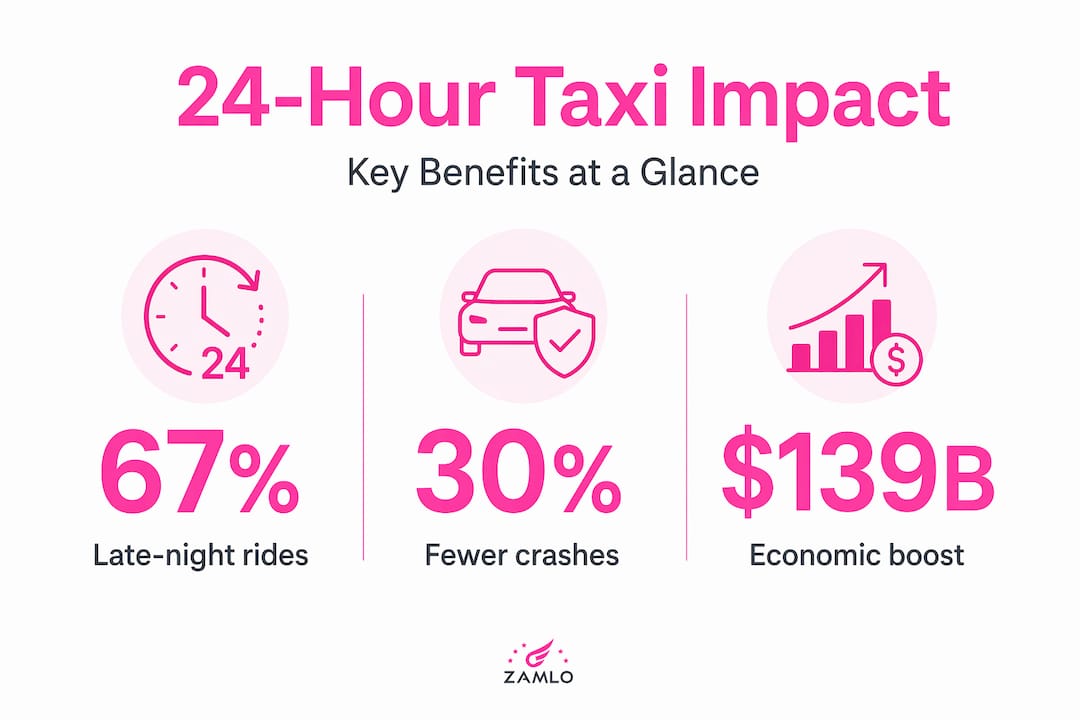
London offers a compelling case. Taxi services contribute to over £139 billion in annual economic activity and support more than one million jobs, largely because the nighttime economy depends on people being able to get home safely after venues close. Without reliable taxis, bars, restaurants, and event venues lose customers who cannot or will not drive themselves.
| Benefit | Who it helps | Real-world impact |
|---|---|---|
| Reduced drunk driving | General public | Fewer fatal crashes during peak impairment hours |
| Flexible travel at any hour | Shift workers, travelers | Reliable transport for non-standard schedules |
| Social inclusion | Elderly, disabled riders | Access to transport when driving is not an option |
| Nightlife economy support | Businesses, workers | More customers willing to go out when they can get home |
| Emergency access | Medical patients, caregivers | Transport available when urgency does not wait for daylight |
The benefits of 24-hour taxis also compound over time. Cities that invest in reliable night transport see higher public transit satisfaction, lower DUI rates, and stronger nightlife economies. The taxi is not a luxury layer on top of a functional city. In many cases, it is the connective tissue that keeps the city functional after sundown.
My take on what most people get wrong about night service
I have spent years observing how taxi operations actually work at street level, and the thing that surprises most people is how thin the margin for error really is. Everyone assumes 24-hour service is standard. The truth is that it requires constant negotiation between driver welfare, business economics, and community need.
What I find most underappreciated is the role taxis play for people who have no visible alternative. The college student finishing a late shift. The caregiver heading home after a hospital visit. The tourist who missed the last train. These riders do not show up in economic analyses, but they are the reason the argument for taxis around the clock matters beyond business logic.
I also think the industry undersells the safety contribution. Companies spend marketing budgets on apps and pricing, but the most powerful thing a taxi company can say is: we were there at 2 a.m. when you needed us, and you got home safely. That is not a small thing. That is the whole thing.
My hope is that as regulation tightens and professionalism increases, the patchwork coverage issues in suburban and rural areas get real attention. The people who live farthest from city centers often have the fewest alternatives, and right now, "24/7 service" does not always reach them.
— Shelia
Ready for a ride that does not quit at midnight?
If this article made you think differently about what reliable night transport actually requires, you already understand what separates a serious taxi service from one that disappears when things get difficult. Diamondtransportation24 operates around the clock because the need for safe, professional transport does not follow a business-hours schedule. Whether you need an early airport run, a late-night pickup after an event, or a reliable option for a shift that ends when most people are asleep, Diamondtransportation24 is built to be there.

Booking is straightforward, drivers are professional, and availability is real. Not just on paper.
FAQ
Why do taxis run all night instead of just peak hours?
Taxis operate through the night because demand from airports, shift workers, and nightlife does not stop at a fixed hour. Airport and corporate contracts also subsidize the slower overnight periods, making continuous operation financially viable.
Are taxis actually available at night in suburban areas?
Availability thins significantly outside urban cores after midnight. Late-night coverage concentrates in nightlife districts and airport zones, so suburban riders should pre-book rather than expect on-demand pickup.
How do taxis improve safety during late-night hours?
30% of fatal nighttime crash drivers between 9 p.m. and 3 a.m. were alcohol-impaired. Taxis provide a professional, sober alternative that directly reduces that risk for everyone on the road.
Do regulations require taxis to operate 24 hours?
Not universally. Most regulations focus on driver standards and vehicle safety rather than mandating specific hours. Finland's 2026 reforms, for example, target driver training requirements and taximeter transparency rather than operating schedules.
What are the biggest benefits of 24-hour taxi service for communities?
Continuous taxi availability reduces drunk driving, supports nightlife economies, provides access for elderly and disabled riders, and keeps shift workers connected to jobs with non-standard hours. London's taxi sector alone contributes to over £139 billion in annual economic activity.