

Not every taxi that shows up is actually reliable. You might assume that booking a cab means you'll get there on time, in a clean vehicle, with a professional driver. But taxi service reliability is far more layered than that, and assuming otherwise is how people end up late, stranded, or unsafe. This guide breaks down what taxi service reliability actually means, how it's measured, how it compares to ride-hailing apps, and how to identify the genuinely dependable options in your area.
Table of Contents
- Key takeaways
- What taxi service reliability really means
- How reliability is measured and tracked
- Taxis versus ride-hailing apps: a reliability comparison
- How to choose a reliable taxi service
- My honest take on what reliability really comes down to
- Why Diamondtransportation24 takes reliability seriously
- FAQ
Key takeaways
| Point | Details |
|---|---|
| Reliability is multidimensional | Safe vehicles, licensed drivers, and consistent on-time arrivals all combine to make a taxi service truly dependable. |
| Punctuality has a clear benchmark | Arriving within 5 minutes of the scheduled time is the industry standard for measuring on-time performance. |
| Taxis have stricter driver vetting | Taxi drivers face more rigorous background checks than most ride-hailing drivers, which matters for passenger safety. |
| Reviews and ratings reveal patterns | Reading recent passenger reviews is one of the fastest ways to gauge real-world service consistency. |
| Local services often outperform apps | For short, urgent trips, regulated local taxi companies frequently offer more consistent reliability than app-based alternatives. |
What taxi service reliability really means
Most people think reliability means the driver shows up. That's the floor, not the ceiling. Understanding taxi reliability means looking at four interconnected dimensions: safety, timeliness, vehicle condition, and driver professionalism. When any one of these falls short, the whole experience breaks down.
Safety is where reliability starts. Taxi drivers undergo more extensive vetting and regulation than ride-hailing drivers, including longer and more stringent background checks. That matters because you're getting into a vehicle with a stranger. A service that skips or shortcuts this process is not reliable, regardless of how fast the car arrives.
Timeliness is what most passengers think about first, and it's valid. But punctuality isn't just about the driver being on time. It's about the dispatch system working correctly, the route being planned well, and the driver communicating proactively if there's a delay.
Vehicle condition affects both safety and comfort. A reliable taxi service maintains its fleet with regular inspections. Worn tires, broken seat belts, and malfunctioning air conditioning are not minor inconveniences. They are signals that the company does not take operational standards seriously.
Driver professionalism covers how the driver interacts with passengers, handles the route, and responds to requests. Service quality dimensions important to passengers include driver professionalism, vehicle condition, and transparent pricing, all of which directly shape perceived reliability.
- Verified licensing and insurance documentation
- Clean, well-maintained vehicles with working safety features
- Professional driver conduct and communication
- Clear and consistent pricing with no hidden fees
- Responsive dispatch systems for booking and tracking
Pro Tip: Before booking any taxi service, ask whether their drivers are licensed through your local transport authority. A company that can answer that question immediately is far more likely to be genuinely dependable.
How reliability is measured and tracked
Knowing what reliability looks like is one thing. Knowing how it's measured gives you a way to compare services objectively. The transportation industry uses specific metrics to track and report on service dependability, and understanding them helps you ask the right questions.
The most common standard is on-time performance, known as OTP. Punctuality is measured by whether a vehicle arrives within 5 minutes of the scheduled pickup time. This benchmark, often called RT+5, is the baseline for what the industry considers acceptable. If a service is meeting this standard consistently, it is performing well. If not, that gap tells you something important about their operations.
There's a distinction worth knowing between vehicle-centric and passenger-centric punctuality metrics. Passenger-centric metrics give a fuller picture of how delays actually affect travelers, because a late arrival impacts the passenger far more than it impacts a fleet's aggregate on-time percentage.
Trip completion rates are another key measure. A high rate of completed trips means the service follows through on bookings. A low rate signals cancellations, driver no-shows, or dispatch failures. Completion rates for accessible trips dropped from 81% to 57% between 2020 and 2024 in the ride-hailing sector, showing how quickly reliability can erode when oversight is weak.

| Metric | What it measures | Why it matters |
|---|---|---|
| On-time performance (OTP) | Percentage of pickups within 5 minutes of schedule | Core punctuality standard for any taxi service |
| Trip completion rate | Percentage of booked trips that are actually completed | Indicates follow-through and dispatch consistency |
| Passenger-centric punctuality | Delay impact calculated from the rider's perspective | Better reflects true reliability experience |
| Wait time variance | Difference in wait between standard and specialized trips | Reveals service gaps for different rider needs |
Pro Tip: When evaluating a taxi service, ask specifically about their trip completion rate. Any company serious about reliability will track this number and be willing to discuss it.
Taxis versus ride-hailing apps: a reliability comparison
The assumption that app-based ride-hailing services are always more reliable than taxis is worth examining closely. The reality is more nuanced, and it depends heavily on your situation.
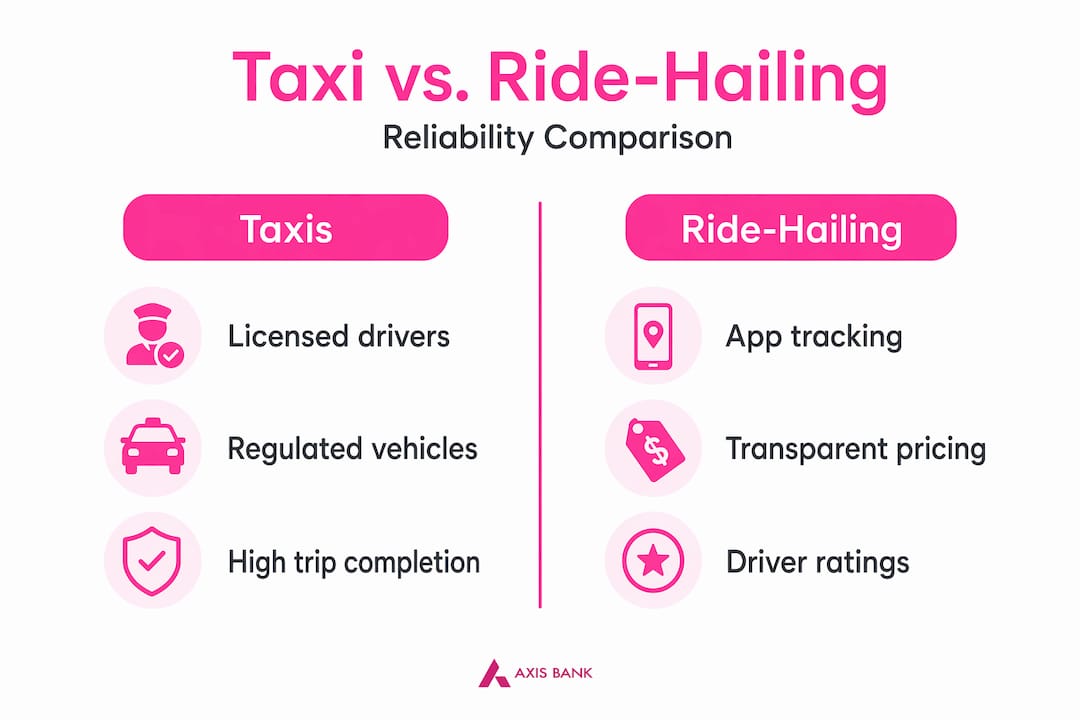
Ride-hailing apps have a transparency advantage. You can track the driver in real time, see estimated arrival times, and rate the experience immediately. That visibility creates accountability. But transparency does not equal safety or consistency. Taxi drivers face stricter background checks and regulatory oversight than most ride-hailing drivers, which is a meaningful difference when your physical safety is the concern.
Traditional taxis remain essential for urgent and short-distance travel, where their regulated nature often provides more consistent reliability for spontaneous trips. Ride-hailing services, meanwhile, tend to perform better for planned trips where you can book ahead and account for surge pricing. Taxi reliability dips during weekday rush hours due to peak inefficiency, which is a pattern worth knowing before you book.
| Factor | Traditional taxi | Ride-hailing apps |
|---|---|---|
| Driver background checks | More stringent, regulated | Varies by platform and region |
| Real-time tracking | Varies by company | Standard feature |
| Price transparency | Fixed or metered rates | Subject to surge pricing |
| Availability for urgent trips | Generally high | Varies by demand and location |
| Accessible trip reliability | More consistent | Significant drop in completion |
The survey data reinforces this. Speed and reliability are the top reasons passengers choose taxi and private transportation services, with 47% prioritizing speed and 40% prioritizing reliability. Neither taxis nor apps win on every dimension. The right choice depends on your trip type, time of day, and what you value most.
- Taxis are generally stronger for safety regulation and spontaneous urban trips
- Ride-hailing apps offer better real-time visibility and ease of booking
- Both modes show reliability gaps during peak hours and for specialized transportation needs
- Price predictability favors taxis for fixed-route travel
How to choose a reliable taxi service
Once you understand what reliability looks like, the next step is applying that knowledge when you're actually picking a service. Here's a practical process that works in most cities.
-
Check for proper licensing and visible company branding. A legitimate, reliable taxi company operates with clearly marked vehicles and publicly verifiable licensing. If you can't confirm their license status through your city's transport authority website, that's a serious red flag.
-
Read recent passenger reviews, not just the aggregate star rating. The overall rating tells you almost nothing on its own. Read the most recent reviews and look for patterns: repeated complaints about late arrivals, rude drivers, or dirty vehicles signal systemic issues, not one-off incidents. Taxi service customer reviews are one of the most practical tools for evaluating local options.
-
Understand the booking and dispatch system. A reliable service has a clear process for taking and confirming bookings, whether by phone, app, or website. Ambiguous confirmation or vague pickup windows are early warning signs.
-
Confirm pricing before you ride. Transparent pricing is a feature of dependable services. Hidden fees, refusal to quote rates in advance, or meters that seem to run fast are all red flags worth acting on.
-
Watch for common scams. Unofficial "taxi" drivers who approach you in airports or tourist areas, unmarked vehicles, and drivers who claim their meter is broken are patterns associated with unreliable or fraudulent services. Reliable taxi options will never put you in that position.
The scale of the taxi industry reflects how many people depend on these services daily. In 2024, NYC taxis completed over 41 million trips, generating $965 million in farebox revenue. That volume is only possible when a system maintains baseline reliability consistently.
Pro Tip: If a taxi service does not have a traceable online presence, registered business details, or recent reviews, treat it as unverified. Spending two minutes on a search can save you from a genuinely bad experience.
My honest take on what reliability really comes down to
I've watched how taxi reliability plays out in practice across urban and suburban settings, and the honest truth is that the data rarely tells the whole story. You can have an operator with great OTP scores that still leaves passengers feeling unsafe because the driver was dismissive or the car smelled like it hadn't been cleaned in weeks. Punctuality matters, and it matters a lot. Travel certainty is what passengers value most, not just faster trips. But certainty is about more than clock times.
What I've found is that the most reliable taxi experiences come from local companies that have something to lose. A regional operator who depends on community reputation tends to maintain higher standards than a faceless national platform optimizing for volume. They answer the phone. They communicate when there's a delay. They hire drivers who will represent them well because they know the consequences of a bad review in a small market.
The misconception that ride-hailing apps are inherently more reliable frustrates me, because it leads people to prioritize convenience features over actual safety and consistency. Real-time tracking is valuable. But a tracked car driven by someone who wasn't properly vetted is not a reliable option.
My advice is simple: choose the service that treats reliability as a standard, not a marketing claim. That means licensed drivers, maintained vehicles, honest pricing, and communication you can count on.
— Shelia
Why Diamondtransportation24 takes reliability seriously
When you need a taxi you can actually count on, the difference between a good experience and a stressful one comes down to the standards the company holds itself to before you ever get in the car.

Diamondtransportation24 is built around the principles this article covers: licensed drivers, clean and maintained vehicles, transparent pricing, and a dispatch system designed to get you where you need to go on time. Whether you need a ride for a medical appointment, an airport transfer, or a late-night trip home, Diamondtransportation24 prioritizes the kind of taxi service dependability that shows up in practice, not just on paper. Explore their services and see what consistent, professional transportation looks like when it's done right.
FAQ
What is taxi service reliability?
Taxi service reliability refers to a service's ability to consistently provide safe, on-time pickups with professional drivers and well-maintained vehicles. It goes beyond punctuality to include driver vetting, vehicle condition, and pricing transparency.
How is taxi on-time performance measured?
On-time performance is typically measured by whether a taxi arrives within 5 minutes of the scheduled pickup time, a standard known as RT+5. Passenger-centric versions of this metric better reflect how delays actually impact travelers.
Are taxis safer than ride-hailing services?
Taxi drivers generally undergo more stringent background checks and regulatory oversight than ride-hailing drivers, which gives taxis a safety edge in many markets. Both modes carry risks, and checking local licensing requirements is always a smart step.
How do I spot an unreliable taxi service?
Red flags include unmarked vehicles, refusal to quote prices upfront, no verifiable license information, and a pattern of negative reviews about late arrivals or poor driver conduct. A few minutes of research before booking can reveal these issues.
Why do some taxis seem more reliable than others?
Local, community-focused operators often maintain higher standards because their reputation depends on repeat business and word-of-mouth. Larger platforms optimizing for volume can sacrifice consistency, particularly during peak hours or for specialized trips.